Best Pet Urine Black Light Detectors for Home Inspection
If you’re trying to reveal hidden pet urine stains or other fluorescing messes, a UV black light detector is essential. This guide focuses on consumer-friendly UV flashlights that detect dried pet urine, in addition to stains, scorpions, minerals, and resin curing. It helps renters, homeowners, and cleaners choose a device that fits daily use, sensitivity, and durability. All five selections below are chosen for reliability, versatility, and practical buyer benefits.
Summary table of chosen products:
| Product | Best For | Key Benefit |
|---|---|---|
| Vansky UV Flashlight 51 LED | General household use | Bright, versatile for stains and scorpions |
| Dokhbem 365nm UV Flashlight | Advanced detection | LCD display, rechargeable, durable |
| GLOSSDAY UV Flashlight 100 LED | Wide-area scanning | Brighter, longer range, rugged |
| Vansky 12 LED 395nm Mini | Compact travel kit | Ultra-portable, easy to carry |
| KOBRA UV Black Light 395nm | DIY inspections | Powerful, broad application range |
Vansky UV Flashlight Black Light 51 LED

Best for: households needing a versatile detector for pet urine, dry stains, and light-scattering tasks. This model helps identify invisible stains on rugs, carpets, and clothing. It also supports outdoor use for scorpions and minerals. It runs on 3xAA alkaline batteries (not included).
Why selected: It delivers multiple-use capabilities in one compact package, enabling quick spot checks and easy mobility around the home. Its 51 LEDs provide broad coverage for common surfaces.
Caution: Battery type is not included; ensure you have spare alkalines for extended sessions.
Dokhbem 365nm UV Flashlight with LCD

Best for: users needing precise detection with a modern readout. This rechargeable unit features an LCD display and 365nm UV light, ideal for pet urine detection, resin curing, and general inspections. It offers USB charging and a 4-hour runtime.
Why selected: The LCD readout reduces guesswork about battery status, and the upgraded 365nm beacon provides reliable fluorescence. It’s a strong choice for frequent use and professional-like accuracy.
Caution: Recharge time is roughly 3–3.5 hours; plan charging accordingly for longer sessions.
GLOSSDAY UV Flashlight 100 LED

Best for: users who want wide-area scanning and high brightness. With 100 UV LEDs at 395 nm, this model covers larger surfaces quickly, suitable for pet urine detection, scorpion hunting, and currency verification. It’s built with durable aluminum and IP44 protection.
Why selected: It offers significantly brighter performance and a longer reach, making it practical for larger rooms or outdoor spaces. The craft and materials enhance reliability during outdoor use.
Caution: Heavier than ultra-compact options; use with a stable grip to avoid slippage.
Vansky 12 LED 395nm Black Light Mini
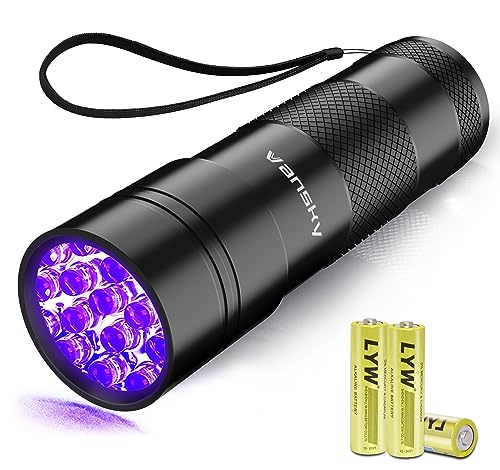
Best for: travelers and quick checks on the go. This compact 395nm unit is designed for pet urine detection in tight spaces, resin curing, and hidden stains. It’s a pocket-friendly option that still provides clear fluorescence.
Why selected: Ultra-portable design fits pockets, bags, or glove compartments, enabling discreet inspections anywhere. It’s ideal for hotel stays or small apartments where space matters.
Caution: Smaller light field means more frequent repositioning may be required for thorough checks.
KOBRA UV Black Light 395nm 100 LED

Best for: do-it-yourself inspections, leaks, and anti-counterfeit checks. This 395nm, 18W device provides strong fluorescence to reveal pet urine, bed bugs, and UV-dyed materials. It’s built for broader application use including currency verification and scorpion spotting.
Why selected: Its higher wattage and broad application range make it a solid all-around option for home and small projects. It supports quick spotting of fluorescing substances across varied surfaces.
Caution: International terms apply; verify compatibility if purchasing outside the U.S. or for specific use scenarios.
Buying Guide
What should you consider when buying a pet urine black light? Size and portability, UV wavelength, brightness and beam shape, power source, and durability top the list. For pet urine detection, 395 nm is common and effective for most household stains. If you need broader coverage, choose models with more LEDs or higher wattage. Rechargeable options offer the most convenient daily use. For frequent outdoor use or tool integration, select rugged bodies with waterproof or dustproof ratings.
How to choose by use case:
- Home cleaning and quick spot checks: look for 51–100 LED options with a comfortable grip and long battery life.
- Travel and on-the-go checks: compact mini UV lights fit in pockets or purses without sacrificing detection capability.
- Professional-grade or frequent use: a higher wattage, LCD readout, and USB-C charging provide reliability and feedback for tasks like resin curing and in-depth inspections.
Surface applicability: UV flashlights will highlight dried urine better on light-colored carpets and rugs. They may have limited effectiveness on very dark materials or non-fluorescent stains. When scanning, move the light slowly and inspect suspicious areas from multiple angles for thorough results.
FAQ
- Can all UV flashlights detect pet urine stains? Most 395 nm and 365 nm UV flashlights reveal dried pet urine as a glow or fluorescence, especially on light surfaces. Effectiveness varies by surface color and stain age.
- Do I need to buy expensive models for home use? No. A mid-range UV flashlight with 51–100 LEDs and 365–395 nm output typically meets most home cleaning needs and stain detection tasks.
- What about resin curing or mineral detection? Many models include dual-use capabilities, such as resin curing and mineral/fluorescent mineral detection, which can be beneficial for hobbyists and DIY projects.
- Are rechargeable options worth it? Yes. Rechargeable units reduce ongoing battery costs and simplify use wherever outlets are available.
- Is a higher wattage always better? Higher wattage often provides brighter light and faster coverage, but portability and beam quality matter too for practical use.
- Can UV lights cause harm to eyes? Avoid direct exposure to eyes. Do not shine into eyes, and handle powerful units with care in dim rooms.