Best Hard Water Cleaning Products for Spotless Surfaces
Hard water creates mineral build-up that dulls glass, tile, and fixtures. The following products are commonly used cleaners designed to tackle calcium, lime, and rust deposits. This guide highlights five well-regarded options, summarizing their strengths and best-use scenarios to help American households choose the right solution for bathrooms, kitchens, and beyond.
| Product | Best For | Notes |
|---|---|---|
| CLR Brands Calcium, Lime & Rust Remover | Multi-surface, bathrooms, kitchens | Fast-acting, versatile for many surfaces |
| Bio-Clean Hard Water Stain Remover 20.3 oz | Windows, tile/grout, glass | Industrial-strength aerosol for tough stains |
| Barry’s Restore It All Hard Water Scale Rescue | Glass, porcelain, fixtures | Citric acid-based, safe near vegetation |
| QONS Hard Water Stain Remover | Shower glass, windows, tile, grout | Natural active elements in paste form |
| EROSMILE Hard Water Stain Remover | Glass, shower doors, tubs | Multi-purpose cleaner for home and commercial use |
CLR Calcium, Lime & Rust Remover

CLR Calcium, Lime & Rust Remover is a versatile cleaner designed to tackle calcium, lime, and rust deposits across multiple surfaces. It’s marketed for use in bathrooms, kitchens, dishwashers, coffee pots, and even exterior siding. From glass and stainless steel to ceramic tile and vinyl siding, this formula aims to quickly dissolve mineral buildup and restore shine. For those dealing with persistent hard water rings, this product provides a broad, fast-acting option that minimizes scrubbing time. Always follow label directions and test on inconspicuous areas first.
Bio-Clean Hard Water Stain Remover 20.3 oz

Bio-Clean’s hard water stain remover is an industrial-strength aerosol developed to address years of mineral buildup on windows, tile, grout, and glass. It emphasizes removing hard mineral deposits efficiently, with a formulation suitable for professional-grade cleaning environments. Users should apply in a well-ventilated area and use protective gear as needed. The product is designed to cut through tough films and restoring clarity to surfaces affected by hard water stains.
Barry’s Restore It All Hard Water Scale Rescue

Barry’s Restore It All Hard Water Scale Rescue offers a citric acid-based formula designed to dissolve dried, hardened calcium, lime deposits, tarnish, and rust on glass, porcelain, metals, tile, vinyl, and stone. Its targeted use includes windows, bath fixtures, appliances, and shower areas. The product emphasizes safety near vegetation and septic systems, making it suitable for homes with sensitivity to harsh cleaners. For best results, apply to affected areas, allow contact time, and wipe away mineral residues to reveal brighter surfaces.
QONS Hard Water Stain Remover
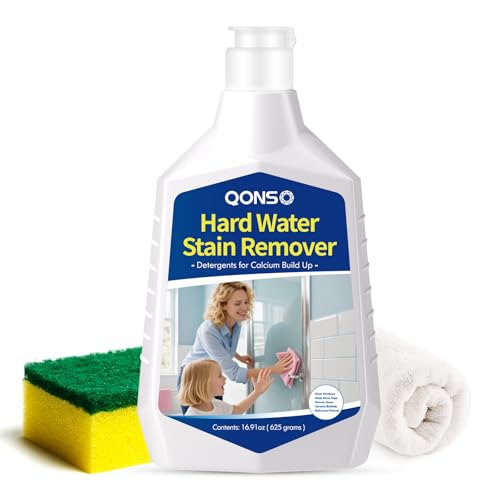
QONS Hard Water Stain Remover is a paste-style cleaner formulated with natural active elements to break down grime and mineral buildup. It targets hard water spots on glass shower doors, windows, tile, grout, and fixtures. This product is designed to tackle years of mineral deposits and soap scum, offering a more tactile application for stubborn stains. Users should apply, let work, then wipe clean to reveal clearer, brighter surfaces.
WUKALAKA—Extra Note: Pumice Stone (Toilet Cleaning)

WUKALAKA’s pumice stone offers a physical method to remove calcium deposits and hard water rings from toilets, sinks, and bathroom tiles. While not a chemical cleaner, it provides a durable option for mineral buildup removal. Users should keep the stone moist during use and test on a small, inconspicuous area first to avoid damaging delicate surfaces. This tool complements liquid cleaners for persistent deposits in conjunction with routine cleaning routines.
Buying Guide: Hard Water Cleaning Considerations
- Surface compatibility: Check whether the product is labeled for glass, ceramic tile, metal, or stone to avoid etching or damage. Some cleaners are multi-surface, while others target specific materials.
- Active ingredients: Citric acid-based formulas are common and generally safer for vegetation and septic systems. Strong industrial solvents may be more aggressive but can require ventilation and protective gear.
- Application method: Aerosol sprays offer coverage for vertical surfaces; pastes and gels stay in contact with mineral deposits longer, which can improve efficacy on stubborn stains.
- Contact time and safety: Follow label directions for dwell time, ventilation, and protective equipment. Test on a small area before broad application.
- Ventilation and fumes: Some products release strong fumes; use in a well-ventilated area and consider wearing gloves and eye protection.
- Environmental considerations: Biodegradable and non-toxic formulas are preferred for homes with children, pets, or gardens. Be mindful of septic system compatibility when choosing cleaners.
- Surface restoration expectations: While many products remove mineral buildup, some may require repeat treatments or gentle scrubbing for thorough results on very old deposits.
- Budget and convenience: Aerosol cleaners can be quicker for quick touch-ups; pastes are effective for heavy build-up but may require more effort. Consider frequency of use and maintenance routines.
Hard water stains vary in intensity and surface makeup. The products above cover a range of approaches—from chemical solution sprays to paste formulations and even a mechanical pumice option—allowing users to tailor cleaning practices to their homes. When selecting a product, prioritize surface compatibility, environmental and safety considerations, and the desired level of maintenance to maintain clear, sparkling surfaces over time.