Best Dry Packs for Storage: Keep Items Safe From Moisture
Direct answer: dry packs for storage protect valuables from humidity, mold, and moisture damage across homes, offices, and workshops. The top picks below are best for different needs—compact, rechargeable, food-safe, or electronics-focused storage. This guide targets shoppers seeking reliable silica gel and desiccant solutions to safeguard spices, jewelry, documents, electronics, and gear.
The following table summarizes the five selected products, highlighting who they’re best for and why they stand out:
| Product | ||
|---|---|---|
| Romeda 15 Pcs 20 Gram Silica Gel Packs | General household storage, small containers | Good adsorption capacity; non-toxic; reactivates in oven or microwave. |
| Dry & Dry 5 Gram 50 Pack | Food, medications, electronics, and pantry items | Clear usage guidelines; large 5 g packets cover many containers; food-grade packaging claims. |
| FURWEY 12 Pack Rechargeable Desiccant Packs, 100g Each | Closets, storage bins, cars; long-term moisture control | Rechargeable with color indicator; sizable 100 g packs; easy to recharge. |
| DryTote Rechargeable Desiccant Packs (5 Pack) | Multiple bins and totes; wardrobe and storage spaces | Rechargeable 100 g packs; color-change indicator signals when to recharge. |
| Wisesorb Silica Gel Packets, 20 Gram, 15 Packs | Various storage boxes and organizers | Non-toxic, cobalt chloride-free; three-side seam packaging; compact 20 g size. |
Romeda 15 Pcs 20 Gram Silica Gel Packs

Best for small containers and quick-moisture protection, Romeda silica gel packets are a compact option for jars, spice tins, jewelry boxes, and electronics organizers. The beads are transparent and non-toxic, with good adsorption capacity suitable for light to moderate humidity. They are safe to use with food, making them convenient for pantry and kitchen storage. A potential limitation is that reactivation may require oven or microwave time, which might be less convenient for large-scale needs.
Dry & Dry 5 Gram 50 Pack
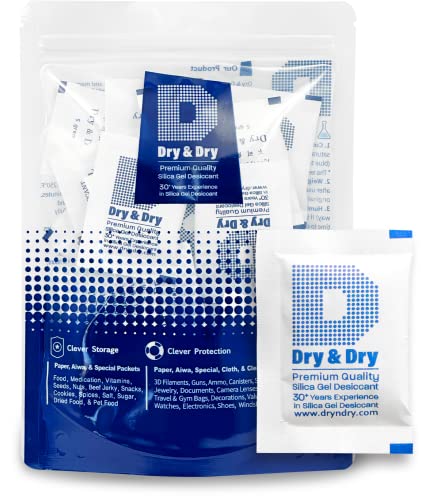
Choose this if you want a ready-to-use bulk pack with a widely referenced size. Each 5-gram packet can serve roughly 600 cubic inches, making it suitable for food storage, vitamins, seeds, spices, electronics, 3D filaments, and more. The kit emphasizes food-grade materials and broad applicability. A caveat is that overpacking a container can reduce airflow, so balance packet count with container size for optimal protection.
FURWEY 12 Pack Rechargeable Desiccant Packs, 100g Each

This option is best for users needing longer-term moisture control in larger spaces like closets, bins, or car interiors. Each 100 g pack offers substantial capacity and a color indicator to show when reactivation is needed. It’s rechargeable via microwave heating and designed for multiple uses, with a recommendation to replace after about 10 uses for best performance. The emphasis on reusability makes it a strong eco-friendly choice, though larger packs may occupy more space.
DryTote Rechargeable Desiccant Packs, 5 Pack

DryTote is positioned for multi-bin or multi-tote storage. The 5-pack provides enough coverage to protect several closets, bins, or storage shelves. The color-change indicator helps users manage reactivation easily. It’s best for households seeking a rechargeable, reusable system and who prefer clear signals when the packs need care. A potential limitation is that success relies on proper reactivation to maintain moisture absorption capacity over time.
Wisesorb Silica Gel Packets, 20 Gram, 15 Packs

Wisesorb offers a compact, non-toxic option with cobalt chloride-free silica gel. The three-side sealed packaging helps maintain integrity and prevents spillages in storage boxes, jars, and organizers. The 15-pack size is convenient for stocking multiple containers and spaces. The main caveat is that users should not rely on a single packet for large-volume spaces; distribute packets for more uniform humidity control.
Buying Guide: Key Considerations For Dry Packs
- Storage space and container size: Match packet weight and quantity to the container volume to maximize moisture absorption without obstructing airflow.
- Reactivation and reusability: Rechargeable desiccants save money over time but require heating. Confirm safe reactivation temperatures and methods (oven, microwave, or sunlight) for each product.
- Food safety and non-toxicity: If desiccants touch food or beverages, prioritize food-grade materials and packaging that specify safety compliance.
- Indicator features: Color-change or indicator-equipped packs simplify monitoring and timing for reactivation or replacement.
- Material and packaging quality: Look for nonwoven fabrics, three-side sealing, and durable seams to minimize leakage and dust.
- Application scope: Choose specialized packs for electronics, optics, spices, documents, or clothing if you store these items in separate spaces.
Practical Tips For Effective Use
- Place silica gel packs in corners and at the bottom of containers for even distribution.
- Avoid overpacking; ensure some airflow to prevent trapped moisture at the item surface.
- Group reactivation steps with a reminder schedule to maintain consistent performance.
- Clean the storage area regularly to maximize the moisture-control benefits of the packs.
Frequently Asked Questions
- What are dry packs for storage used for? They absorb moisture to protect items like spices, jewelry, electronics, and documents from humidity damage.
- How often should I reactivate rechargeable desiccants? Reactivation intervals depend on humidity levels; use the color indicator and follow manufacturer guidelines for time and temperature.
- Are silica gel packs food-safe? Some packs are labeled food-grade; verify packaging and certifications before use near consumables.
- Can I reuse desiccant packs indefinitely? Many packs are reusable, but performance may degrade after multiple cycles. Replace or refresh as needed per product instructions.
- Do I need a desiccant pack in every storage container? Not always; assess humidity risk and container size. A few packs per larger space often suffice.
- What should I do if a desiccant pack leaks or breaks? Replace the packet immediately and inspect surrounding items for moisture exposure.